

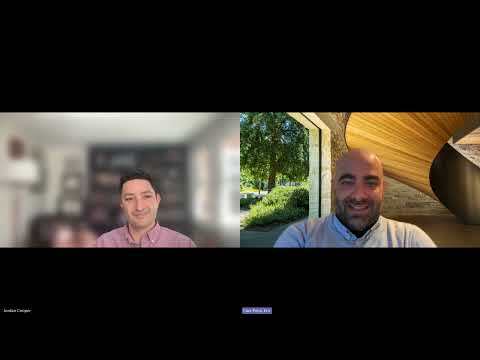
Healthy Data Podcast Eric Cioe-Pena (Northwell Health) & Jordan Cooper (InterSystems)
April 8, 2026, 4:39PM
27m 53s
Jordan Cooper 0:03
the founding director and vice president of Global Health at Northwell. Eric, thanks so much for joining us today.
Eric Cioe-Pena 0:10
Thanks for having me.
Jordan Cooper 0:11
As background, Northwell Health is a health system based in Long Island, New York, specifically Melville, right in the middle, with 6600 beds and 14,500 providers across 24 hospitals and other care facilities with 100,000 employees. So Eric. We're excited to be talking today about Guyana, Ukraine and why a health system in the United States should be caring about international medicine. So please tell us a little bit about what you're doing in those countries and what your what your global health program is up to these days.
Eric Cioe-Pena 0:43
Yeah, thank you. It's great to be here, like I said. And you know, it's been a privilege at Northwell. I've been, I've been the kind of founding director and now vice president of the Center for Global Health at Northwell since 2019 when we founded it. And it really was answering the question, you know, can a health system do something a little bit more? Than, you know, the traditional medical mission model where we let, you know, it's basically where we passively allow physicians to go out and do this work internationally that they like to do and that they enjoy doing. Is there a way that we could organize it, put some structure around it and have that energy get captured and be a better? Value to a partner internationally and actually serve some value to the health system. And that's really kind of what the Center for Global Health's thesis forming thesis was, was, you know, can we take all of this goodwill, all of this desire to give back and travel abroad and teach and really organize it around specific projects?
Click to read the full transcript
Jordan Cooper 1:34
Mhm.
Eric Cioe-Pena 1:42
And we, we, as you said, we have two big projects that we work on our flagship project in Guyana, which is the only English speaking country in South America. And then Ukraine is our second, second site, which really started at the request of the CEO Emeritus, the prior CEO of Northwell, Michael. killing after the full-scale invasion in 2022 of Ukraine.
Jordan Cooper 2:06
Excellent. So let's start with Deanna. I understand that they're undergoing a digital transformation from paper to electronic health records. So many of our more seasoned and tenured listeners may remember this happening in the United States a few decades ago. What's the program looking like?
Eric Cioe-Pena 2:26
Yeah. So right now we've got a program that has, you know, we're we're engaged in over 17 departments and service lines in Guyana. So there's really a lot of activity. It's one of what we call a core site, which really means that the health system has engaged in a five-year partnership with the government and. The largest public hospital there in in essentially doing in kind health care kind of advocacy and health system strengthening work based on what they need and so everything from psychiatry to pediatric urology. You know, you know we've we've basically brought to bear in Guyana one of the big projects that they're doing as you mentioned is they've they've kind of contracted their first electronic medical record and as they're building new hospitals and and and starting to bring new facilities online, they're also looking at digitizing kind of their existing health. Help. Records and health infrastructure. It's a pretty daunting task. I think right now at most hospitals in Guyana, the amount of medical record storage is probably a fire hazard in most of the in most of the hospitals. You know, like even the, you know, we say it in jest, but the CEO of of GPHC, which is the large public hospital, the coronary care hospital in Georgia.
Jordan Cooper 3:28
Mhm.
Eric Cioe-Pena 3:43
Georgetown, which is the capital, you know, said that like they were actually in the file room, they ran out of space to put their medical records because they had so such a volume of paper records. And when you think about modern care delivery and how complicated modern care delivery is to try and document that effectively on paper is essentially impossible. And so they realized very quickly that they were going to have a kind of enormous challenge, not only in switching to an electronic medical record that's hopefully starting from all the mistakes of the past, you know, 30 years of medical records. But but not only that, they had this enormous wealth of paper data that they were going to have to in some way. Kind of make workable and usable. So we've been working with them and other New York health systems are engaged on that. Our specific cut out right now is in the pre-hospital space and we're looking at taking their ambulance service, which isn't isn't a national ambulance service and creating a national ambulance authority that. Will respond to emergencies countrywide, dispatch ambulances, provide a record of patient care and then have that record of patient care seamlessly integrate into the larger hospital system's EMR. And so that's the kind of the piece of this that we've taken on and are spending a lot of time thinking about right now and it's even that. I think has enormous, enormous challenges and things that you wouldn't think of coming at this from the United States.
Jordan Cooper 5:09
So, Eric, there's just a million topics you covered talking about that. You know, let's talk about the specifics of what Northwell is providing. First of all, I'm thinking, is it mentorship? Is it actual physicians and nurses, provider caregivers giving care? Is it consulting? What exactly, specifically?
Eric Cioe-Pena 5:27
Yeah.
Jordan Cooper 5:29
Are the resources being allocated from Northwell to Guyana?
Eric Cioe-Pena 5:33
So it's a little bit of all of the above that you just mentioned with an emphasis on we're trying very hard not to be the ones providing medical care. So with very limited exception are our docs and nurses functioning as docs and nurses in.
Jordan Cooper 5:41
Mhm. 3. Mhm.
Eric Cioe-Pena 5:49
In Guyana, it's really we do some campaign based work where we do some surgical campaigns and help them clear backlogs, but that's the exception and not the rule. I would say the rule of it is really in kind consulting, mentorship, leadership development, everything from, you know, launching a new. Modality of psychiatric care. So electroconvulsive therapy, which has been used in the States for years and years to for refractory depression and schizophrenia. We launched that service with the public hospital in Guyana. So help them acquire the machines, trained all the nurses, the anesthesia docs, the psychiatrists, so they were able to deliver this modality. Of care and then helped them launch that service and then provided kind of not just tech support, but in kind support kind of to the program moving forward. And so that's one example, but it's really kind of full thickness partnership I think is the best way to describe it. Our docs get a lot out of this. To like our doctors come back from these projects and they say, you know, I spent a week there in country. They've now normally the week visit of from an attending physician is buttressed by weeks and weeks of virtual meetings before and after. But then you know, we encourage a lot of our providers to do a site visit to see the country, to see the providers, to see the.
Jordan Cooper 7:02
Mhm.
Eric Cioe-Pena 7:08
The clinical environment for themselves and they come back and they say, you know, this has been one of the most valuable parts of my career in terms of the exposure, the ability to form kind of intercultural professional bonds with people in the same discipline that are facing very different.
Jordan Cooper 7:24
Mhm.
Eric Cioe-Pena 7:28
Challenges. And there's a kind of a what's gets described as a kind of a purity of the medicine, you know, cause most countries, it's not hard to go to a country that has less focus on medical, legal and billing than than when you leave the United States. Basically any country you go to in the world, you're probably doing a little bit better than you would be doing here.
Jordan Cooper 7:29
Mhm. Mhm. OK. Yeah. So you, you know, there's great expense associated with all of this. Is all this funded by Northwell Health's largesse or is there funding from the World Bank or IMF? And this is going back to the original. Premise of this conversation, which is, you know, for any of our listeners this episode, why would they be interested in initiating some sort of like program at their institution? So funding and ROI.
Eric Cioe-Pena 8:19
Yeah, it's it's a great question and it's a question I get asked often, as you can imagine. You know, it's it started out 100% seeded from the Northwell budget. This was kind of an idea, a twinkle in an eye. And so it's tough to get funders, especially when you're 30 years behind. Kind of the other major academic medical centers in terms of global health development to say, hey, fund this idea that we have. So it was seeded through Northwell's budget and Northwell still has significant stake in the game. But I our programmatic expense, the expense of travel, the expense of our.
Jordan Cooper 8:45
Mhm. Mm-hmm.
Eric Cioe-Pena 8:58
The expensive kind of program delivery has been offset about $0.70 on the dollar, and that's offset by either government grants, so direct from the government of Guyana or the government of Ukraine, individual donors. So we have an individual donor pool that is interested in this kind of work.
Jordan Cooper 9:04
Mhm.
Eric Cioe-Pena 9:17
And seeing this kind of work work and and then the other part is is still you know there's about $0.30 on the dollar that's Northwell budget funded and that that's kind of our stake in the in this in saying that this is important in our part of the partnership.
Jordan Cooper 9:19
Um. So since this is Healthy Data podcast, I'd like to ask a few data centric questions. Data centers, connectivity, broadband infrastructure, latency. These are questions I'm sure many listeners are considering. Obviously you know clouds, is cloud an option?
Eric Cioe-Pena 9:38
Sure. Yeah.
Jordan Cooper 9:51
Out there commercial cloud. Is it only on Prem? What about data security? Security of a data center? Is there a data center there? How you know please?
Eric Cioe-Pena 9:59
Yeah. Yeah, no, it's great. Those are all great questions. And it's funny because this week I'm grappling with some very similar questions with, you know, with computer assisted dispatch for for 911 and EMS. You know their their cloud is is a feasible option in Guyana. Broadband Internet is pretty ubiquitous. Certainly in the capital and in the coastline cities, you know direct broadband or 5G or LTE style kind of mobile service is is pretty ubiquitous in the hinterland of Guyana, which you know, 95% of the Guyanese population lives on the Atlantic Coast. On the North Coast, the other 5% lives in a a very large part of area that's got very low population density, you know population centers of 2000 or less. What the ministry has done, the Ministry of Health has done in those cases is they set up health centers and health outposts and each one of them is set up with.
Jordan Cooper 10:48
Mhm.
Eric Cioe-Pena 11:00
A low Earth orbit satellite connection and it's actually all Starlink at this point cause Starlink is the most reliable of the low Earth orbit at least in in in in South America. So so you know we we're we're able to not only digitize the health post but it actually.
Jordan Cooper 11:13Mhm.
Eric Cioe-Pena 11:20
It's got enough broadband that we actually give the community members digital access as well. So they are able to get online for a certain amount of time per day where they can log in and check e-mail and access the digital services the government is offering. But it does have its its limitations and you know we've been thinking about things like everything.From, you know, ambulance connectivity and EPCR and and remote, you know, computer-assisted dispatch all the way through to like remote robotic surgery, which the president of the country has challenged us to do in Guyana. You know, things like latency are really important, right? And now in low-earth robot satellites you can you can kind of plan.
Jordan Cooper 11:49
Mhm. Mhm.
Eric Cioe-Pena 11:59
And for the latency, like it's low latency and then there's some interruptions like scheduled interruptions in the connectivity that we're thinking about, but it's certainly a challenge. The data privacy laws in Guyana, again, that's something that we're working through right now with the National Data Management Authority because there is a law that says that most health data needs to.
Jordan Cooper 12:05
Hm.
Eric Cioe-Pena 12:19
Stay in Guyana on, you know, on premises somewhere, they don't really have the data center needed to run. You know, the cloud would be a much better option for them in terms of computer assisted dispatch software and we're trying to figure out kind of how that's going to work. But these are, you know, really relevant questions.
Jordan Cooper 12:22
Mhm. Mm-hmm.
Eric Cioe-Pena 12:38
That the government is struggling with right now, which is how do we protect our citizens data? How do we not let regulation get in the way of digitization of our health system, which is badly needed, and balance kind of those two competing forces? Add the third part, which is. Because Guyana is so small, the population of the country is under a million people and it's a new market for most of these companies. Even getting companies to pay attention and sell their cloud service to a place like Guyana where they view, you know, a new regulatory risk is being a legal risk. Is it worth it given the low?
Jordan Cooper 13:00
Mhm.
Eric Cioe-Pena 13:15
Numbers of patient encounters. It's been, it's been challenging math for us and it's one of the things that I think kind of countries that still have developing healthcare systems are having to contend with. I remember having a conversation with the Prime Minister of Barbados and she told me that, you know, they called Epic to bring Epic to Barbados and they didn't even return their phone call.
Jordan Cooper 13:19
Uh. Mhm.
Eric Cioe-Pena 13:35
Because it's too small of a market. And so, you know, there are just, there are challenges that I think these countries face that we don't even think about sitting in New York, you know, with the, you know, the world at our fingertips.
Jordan Cooper 13:36
This. Mhm. Well, all right. Well, this is an interesting conversation and that's why we're having an unhealthy data podcast before we go to Ukraine. And I want to get to that topic. You know, I just, it wouldn't be a podcast in 2026 if I didn't mention Gen. A I. But here's the thing. I'm only mentioning it because I see a particular use case that could be really interesting that I bet not many health systems in the United States are leveraging it for. Is there any application of Gen. AI to ingest all the paper records in a more expedited? Ash and then simply scanning them or manually typing them in.
Eric Cioe-Pena 14:28 I I certainly think so. I actually think and I've and I've talked to the president and the Minister of Health about this and I and and I think I think the difficulty with Gen. AI is unless you have kind of the local champion who understands.
Jordan Cooper 14:43
Mhm.
Eric Cioe-Pena 14:44
The language, potential and risk and can articulate that to the non kind of non-expert in a way that they feel comfortable. It's almost like you false start, like they're like, yeah, we want to do it. How do we do it? Like do you, like do you just call anthropic and say, hey, we got, you know, 100 and.
Jordan Cooper 14:52
Mm-hmm.Yeah.
Eric Cioe-Pena 15:04
50 million pages of patient data that we'd like you to ingest, like it's really hard to figure out where to start there. We've had a couple of good conversations with some AI, Gen. AI healthcare companies that want to help Guyana with this, but I think the problem is, is that.
Jordan Cooper 15:04
OK. Hmm. Mhm.
Eric Cioe-Pena 15:20
We're we're far enough along that they don't want to really prove concept with a pilot for us and they're not far enough along where they're going to get a big contract from us to do this because in our mind it's unproven still or in the guy in these minds. And so we're in this Gray zone where we're not sure how to kind of proceed forward, but there is this and then the second part.
Jordan Cooper 15:31
Yeah.
Eric Cioe-Pena 15:40
Part of this is they you know the the company that they went with for the their EMR is a it's a British company. They've had some some EMR success in in in the Caribbean but but Guyana is their biggest project ever and and there's kind of this wonder will the EMR even be able to ingest.
Jordan Cooper 15:51
Mhm. Mhm.
Eric Cioe-Pena 16:00
The level of data that the that an A.I. would pull from and and and kind of how would that work. And so a lot of questions unanswered and I feel like that's probably something that we should be more prescriptive and thoughtful about, but we're ending up being reactive because there are so many other competing priorities right now in.up this this this electronic health record.
Jordan Cooper 16:22
Well, I appreciate you delving into that. Thank you for indulging me. I'd like to pivot to Ukraine. What's going on there? Obviously it was a priority for the previous CEO of Northwell. What are you doing on the ground there?
Eric Cioe-Pena 16:25
Done.Yeah.Yeah, so, you know, Ukraine's been something that's also near and dear to my heart. It started as a telemedicine service where in 2022 in addition to working with the with the government. Hospitals in providing supplies and needed equipment, which really started after the Russian full-scale invasion in February of 2022. We started talking to hospital directors and asking them, you know, would would telemedicine be helpful to you? We were coming out of COVID. We had just learned kind of all these things we could do with kind of virtual patient monitoring. And telemedicine and virtual second opinions. And and we were looking to see if there was a way that we could be helpful, honestly. And we were, we were empowered by the CEO to to make it work. And I'll be honest with you, what we envisioned and what I think we thought the system was going to be.
Jordan Cooper 17:21
Mhm.
Eric Cioe-Pena 17:27
Is not ended, did not end up being what it actually ended up and what was helpful. You know, I think we somehow imagined that we'd have like a camera in a trauma Bay and we'd be helping direct resuscitations. It became very clear, you know, you only have to be at war for a small amount of time before your docs become really good at taking care of penetrating trauma, right? Like.
Jordan Cooper 17:28
Hmm. Mhm.
Eric Cioe-Pena 17:47
You know, like it, nothing. Nothing gives you expertise like experience. So we we really found ourselves like not expert at managing wartime trauma compared to our Ukrainian colleagues who were seeing it day in and day out as the war marched on.
Jordan Cooper 17:47
Mm-hmm. Mm-hmm.
Eric Cioe-Pena 18:04
What ended up, what ended up being really valuable to them, and it was important that we had the kind of operational flexibility that we could really, we were building the plane as we were lifting off. So we really kind of had the ability to modify what the use case was as we were talking to the Ukrainians. It ended up being a.
Jordan Cooper 18:16
Mhm.
Eric Cioe-Pena 18:24
Virtual second opinion service for really complicated medical patients whose care was severely disrupted by the war because specialists were scattered around the country, because big, big centers of excellence were either bombed or at risk. You know, these patients that had really kind of fragile cases that needed.
Jordan Cooper 18:31
1.
Eric Cioe-Pena 18:43
Lots of different specialist and subspecialist interactions. Think pediatric cancers. Think really complicated surgical surgical approaches. Northwell physicians were really helpful in managing those cases as kind of a copilot that sat alongside the Ukrainian doc that had training in some.
Jordan Cooper 18:46
Mhm.
Eric Cioe-Pena 19:03
But not all of the of the care and helped provide kind of a full suite of care to these patients. And so the ones that I really remember the most are the pediatric cancer referrals. We had a couple of you know transplant cases where we were working with working with patients that were scheduled for transplant before the.
Jordan Cooper 19:22
Mm-hmm.
Eric Cioe-Pena 19:22
War that needed optimization and then transplant elsewhere and how do you know answering complicated questions about how you manage that patient as they're waiting for a transplant that's now you know the the date of which is not certain. You know it it it became really nuanced and it and it but it took off and you could tell that it was valuable because the.Ukrainians kept calling and that was kind of to me, the measure of success. The more that we, I said, the more that they hit the button to get us on the phone, the better this was going to be done. And to date we've done, you know, over 1500 of these virtual second opinions and it was a model for Northwell Health's.
Jordan Cooper 19:48
Mhm.So.
Eric Cioe-Pena 19:59
Contract with the Department of State, where we now do this officially for every embassy and consulate around the world for the United States government. And so, yeah, it ended up, it started as, you know, very altruistic and ended up being a business development plan. Yep.
Jordan Cooper 20:07
Oh, interesting. So it was a business development play, really. So we are approaching the end of the podcast episode and I do have a closing question, but penultimately before we get to that one. So on this Ukraine topic, I do have to ask at least one data question. So you have Northwell providers in the New York tri-state area.
Eric Cioe-Pena 20:30
Yeah.
Jordan Cooper 20:36
And then you have patients and providers in Ukraine. Now I'm presuming that the providers in Ukraine are looking at an electronic health record and they're asking for support from providers across international boundaries in the Atlantic Ocean.
Eric Cioe-Pena 20:39
Yeah.
Jordan Cooper 20:51
So the question that I would like to pose to you is how are you facilitating viewing of the patient's EHR in real time and allowing Northwell physicians to navigate through it in order to provide recommendations because I'm sure just having me on the phone. Is inadequate to allowing me to have direct access to the EHR in order to provide that second opinion. So how are you facilitating data access across thousands of miles and international boundaries to support the real time decision support?
Eric Cioe-Pena 21:17
Yeah. That's a great question. The short answer is not well, but but you know and it's and it's evolved as the as the as our understanding in this program has evolved. I mean for most of the things that they want us to to to review that are really complicated are radiology images. And so we do have an import tool where we're.
Jordan Cooper 21:29
Mhm. Mhm.
Eric Cioe-Pena 21:45
Able to import but sandbox the the Ukrainian data in a in a kind of sandbox where we can review the images for a set period of time, kind of collaborate on the care and then you know we memorialize the our recommendation in some sort of usually an e-mail honestly and then that.
Jordan Cooper 22:04
OK.
Eric Cioe-Pena 22:05
That data is then is not doesn't become part of the Northwell EHR. They were never Northwell patients and that data gets purged and it's really just native. It's it's memorialized only in the Ukrainian EHR. But to say that that was a little bit of a little bit of the fog of war and a little bit of a nightmare from a compliance standpoint is an understatement.
Jordan Cooper 22:17
Mhm. Mhm.
Eric Cioe-Pena 22:25
We had to go through a lot of iterations of what would, what would not. We wanted to make sure that the Ukrainian government had assured us that they were not going to get upset with us about this. They actually gave us a blanket letter from the Minister of Health that as long as there was a Ukrainian Dr. in the loop in these discussions, we were OK from a data privacy, from a licensure standpoint and from a.
Jordan Cooper 22:42
Mhm.
Eric Cioe-Pena 22:45
Risk standpoint, what we were worried about then was is if we took on too much data and had too many kind of too many thoughts happening between the patient and the doctor with the US doctor sitting here that the US may in someday someday determine that that was AUS covered patient under HIPAA and all these other things.
Jordan Cooper 23:02
Mhm.
Eric Cioe-Pena 23:03
And and that became a concern that we needed, wanted to make sure we were we mitigated around but but it but it was challenging and it's and it's still not a perfect system. In an ideal world it'd be like 2 epic tenants just pushing pushing the data to another one and I barely know what that means.
Jordan Cooper 23:16
Mhm. The care everywhere isn't actually everywhere.
Eric Cioe-Pena 23:21
Yeah, I mean, I, I, and it's funny because I, you know, I'm just learning what care everywhere. We just switched to Epic in at our health system. So I'm just, I mean, like I'm a, I'm a freshman when it comes to kind of Epic. I've been used to a lot less functional system. And so we've had to think outside the box a lot as a health system.
Jordan Cooper 23:27
Yeah.Yeah.
Eric Cioe-Pena 23:40
Because we've had data systems that just weren't supportive of interoperability and and data pushes and I, you know, I think that that's that's a big challenge to to global healthcare delivery kind of worldwide that is still a major threat to our ability to deliver high quality safe care.
Jordan Cooper 23:45
So.You know, a lot of times throughout many of these episodes, guests on Healthy Data podcast will say, you know, tech has its challenges, but a lot of times it's people, regulations and processes that really pose the greatest challenges to have any successful technological innovation introduced. I'd like to wrap up this episode with the final question for you, Eric. I'm going to return. I kind of posed it earlier, but I'd like you to wrap up on this. We've spoken about Guyana, we've spoken about Ukraine, we've spoken about a lot of interesting work that Northwell Health is investing in with these projects. I'd like you to speak to either yourself in 2018 before this started, or to any listener now who doesn't have a similar program across the United States. How would you speak to to to them or or to your earlier self about the ROI? Why is this something that the President of XYZ Health System should? Consider authorizing for them. How? You know, we just heard that there is business development opportunities with the US State Department that inadvertently came as a result of Northwell's well-intentioned effort to get involved with Ukraine. How would you present the return on investment for any other health system that may be interested in investing likewise?
Eric Cioe-Pena 25:14
Yeah, I I I think that the the the there's there's a couple of things. I mean one of them which is the hard data that I can use is the global health program since its inception has cost anywhere from much less than $1,000,000 to just under $1,000,000 a year. In that time, we've accumulated, our marketing team estimates accumulated about $212 million worth of earned media from activities and programs. So that's the that's my hard number. That's the one that I like to put out in the fine at the beginning of the budget meeting.
Jordan Cooper 25:43
Hmm.
Eric Cioe-Pena 25:50
The softer numbers are our docs want to do this. Our docs were looking to do this in any way around the system, through the system, without the system knowing things were leaving our shelves and just walking to other countries kind of Paul Farmer style where like, you know, you know, we we were building things that we didn't even know we were doing. Our docs want to do it because it gives our doctors autonomy and purpose in ways that the US healthcare system can't anymore. And that's just the reality. And until we fix US healthcare that doctors are not frustrated every time they have to write a prior auth or, you know, do something else about their job, that's kind of the sludge that. They muck through to get to the actual patient interaction that brings them joy. This is a shortcut. Global health gives them an amazing amount of autonomy and purpose, and it's an amazing retention and recruitment tool. And I can't quantify it. I have a very hard time. I'd have to pay a consulting company, and I know this thousands are.
Jordan Cooper 26:43
OK.
Eric Cioe-Pena 26:49
Hundreds of thousands of dollars to quantify that for me and it's just not worth doing it right now, but it certainly is there and it's it's unfortunately intangible enough that it doesn't save me during my budget meeting, but it's an but it's important enough to mention because uniformly across all of our docs we have.
Jordan Cooper 27:01
Mm-hmm.
Eric Cioe-Pena 27:09
Just rave reviews about the program, about their engagement in the program, about how well it's set up, and it's a reason why they choose and stay at Northwell.
Jordan Cooper 27:15
Mhm. So burnout is a big issue across the industry, especially with technology expanding and a number of obstacles between the provider and the patient. So I think that's a valid answer that will resonate with many of our listeners. Eric, I'd like to thank you for joining us. Today.
Eric Cioe-Pena 27:39
It's a pleasure. Thanks for having me.
Jordan Cooper 27:40
And for our listeners, this has been Doctor Eric Choi Pena, the Founding Director and Vice President of Global Health at Northwell. Take care, Eric.
Jordan Cooper stopped transcription