

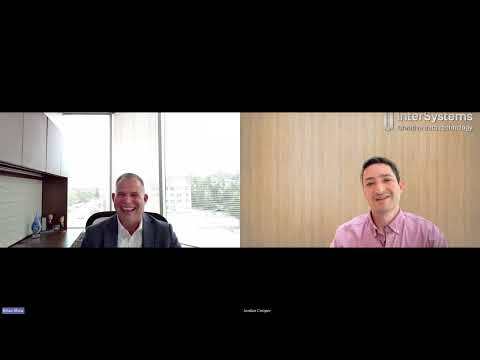
Healthy Data Podcast Brian Shea (MedOne) & Jordan Cooper (InterSystems)
June 29, 2026, 2:08PM
25m 41s
Jordan Cooper 0:03
Brian Shea, the CIO of MedOne Healthcare Partners. Brian, thank you so much for joining us.
Brian Shea 0:08
Thank you. Thanks for having me again.
Jordan Cooper 0:10
For our listeners, Brian is a repeat guest on Healthy Data Podcast. He was here a year ago. Today, we'll be discussing finding alternative revenue streams. But a word of background on MedOne Healthcare Partners. Founded in 2000, they've grown to become the largest physician practice exclusively based to hospital medicine in central Ohio. They're based in Columbus, Ohio. And yeah, so they've developed an interesting product. And Brian, I'd like to ask you, we covered it on the last episode, but just to bring our listeners back up to speed, could you provide a brief overview of One Connect, how a physician practice, a physician-owned practice developed One Connect? who owns it now and the whole journey of getting from A to B.
Click to read the full transcript
Brian Shea 0:59
Sure. Yeah, so I know our last conversation we met a year ago, we actually were describing the tool that we've created internally for MedOne, which was really helped with two areas of focus. I know you mentioned we're a hospitalist group, but we're the state's largest physician-owned post-acute care provider.
Jordan Cooper 1:07
Yeah.
Brian Shea 1:17
as well as now in primary care as well. So that tool that we created that we talked about last time was called One Connect. It was an internal tool developed by providers for providers, really to help in two areas. One was the workflow of our post-acute care providers, documentation,
Jordan Cooper 1:17
Mhm.
Brian Shea 1:38
within it, it has integrations with EMRs that were at those facility sites. Then we also talked about how we created a product, a bed board product that was used in our acute side. And when you were a patient that kind of transitioned from the post-acute world or one of the long-term care facilities into one of our hospital facilities that we managed, it would pop up and we could actually see and have instant access to all that information on those patients across from the post-acute care facilities into the acute side, which was, you know, a game changer, you know, for our providers to have that real-time data and notes and interact back and forth with the providers across. So kind of where we went, fast forward a little bit, is that product, as I said, was developed by MedOne.
Jordan Cooper 2:04
Yeah.
Brian Shea 2:23
you know, all in-house using third-party developers and some internal developers for the product. And we were kind of at a crossroads with many organizations that developing your own software can be daunting, can be expensive. And as I said, you know, we're physician-owned, so our shareholders are our doctors. And, you know, in many cases, not all shareholders or doctors want to be a software company, you know, as well, right? You know, they want to focus on clinical care. Some do. You know, as MedOne, we also looked at how do you continue to diversify, you know, revenue streams, you know, all those different things came into the equation. We actually brought in a third party to evaluate our software.
Jordan Cooper 2:49
Mm-hmm.
Brian Shea 3:07
It's one of those things of, you know, no one thinks their own baby is ugly, right? You know, until someone comes in and tells you that. So it was important for us to have a third party set of eyes to evaluate our product that it wasn't just another EMR, you know, in that space. Is it competitive? Do we have a differentiator there? Is there something really special here?
Jordan Cooper 3:11
Mhm. Mhm.
Brian Shea 3:28
And it was determined that it is unique, you know, enough because it covers, you know, I think the biggest thing we always go back, it was designed by providers for providers, right? It wasn't a tech company that, you know, could leverage technology and tried to force something down into this is how we think a provider should operate. This was actually designed by providers
Jordan Cooper 3:43
6. Mhm.
Brian Shea 3:49
to help improve the, you know, their workflow, right? You know, and, you know, we always focus a lot, especially being physician-owned, on physician experience, you know, patient experience, of course, but physician experience, because if the physicians aren't healthy and able to operate and do their job effectively, there's a trickle-down effect, right, you know, to, you know, to that.
Jordan Cooper 3:53
Mhm. Right.
Brian Shea 4:09
So the determination was made to proceed, you know, with spinning this off into a separate organization. And I could get into the, you know, a little bit more details there, but I'll let you ask a question.
Jordan Cooper 4:21
Yeah, so, okay, interesting. So, because again, a lot of our listeners to this episode right now may think, well, I work at a large healthcare delivery organization. I know that our margins are compressed. Often, most integrated delivery system, network systems in the United States have a 1 to 3% margin. Sometimes they fall below that, and you've seen various large health systems. One just last year went into bankruptcy. And so you're always seeing how do these health care systems find new revenue streams? I think a lot of listeners may be interested in, all right, so you develop this tool. You're A physician-owned practice. This tool is useful for yourselves. And now you're thinking, is there a way to monetize it? And the idea is either you own it and you license it out, or you spin it off and get a one-time infusion or potentially royalties. And then there's also the agreement of, well, can our providers continue to use the tool that we developed for ourselves? Are we going to have to now license our own thing from somebody else who we sold it to? Can you talk about the business implications of now you have this one connect tool, you have a lot of provider buy-in, you have physician experience improving and high physician satisfaction. What are kind of, when you're at a crossroads, what are the business implications and how did you, how did your team decide to go one way versus another?
Brian Shea 5:45
Yeah, that's a lot, right? You know, but sure, and let me try to tackle this a little bit. And, you know, we're right in the middle of all of this as well, right? So this is relatively fresh to us as an organization. Once it was determined that the best direction for the continuation of our product to make it something different,
Jordan Cooper 5:46
Yeah. Mhm. Mhm.
Brian Shea 6:05
and take it to really to the world, was spinning it off as a separate organization. Our initial plan wasn't necessarily, you know, of course, diversifying cash flow and revenue sources and different things like that is always, you know, comes comes into play.
Jordan Cooper 6:20
Mmh.
Brian Shea 6:24
First and foremost, we were also trying to look at how do we have a tool that MedOne can use that is a differentiator. So I kind of wear 2 hats, right? You know, so I am the CIO for MedOne Healthcare Partners. And I, of course, am helping as part of this transition of our spin-off company. Our product was already in the cloud. right? You know, so it was already 100% cloud-based. It was an easy transition for us to think of creating a SaaS-based type solution that could be a subscription-based model and MedOne becomes the very first customer, right, you know, of that. So it's kind of a win-win. We have a solution that we can continue to have life of its own.
Jordan Cooper 6:51
Mhm. Mhm. Yeah.
Brian Shea 7:02
right, you know, and be built out. And where we even envisioned all these other things with it can now become reality, right? Because the way that the structure of it is going to be done and MedOne still have a lot of influence and guidance into this product and make it that much better for our providers. Of course, it reduces our overall expense, right? You know, as MedOne, because we now move to a more defined subscription-based model, you know, for the product itself, like any other SaaS solution that I may use here at MedOne, right? So that piece, it becomes completely separate. The new company name is Memory Health.
Jordan Cooper 7:26
Mhm. Mm-hmm.
Brian Shea 7:44
and the product is called Memory. And think of M, so it's spelled M-E-M-R-Y. So think of the M and the Y, My EMR, inside it. We really love the One Connect name, but as you go through expanding up a new company, there's a lot of things we learned, right, as this as well as just because
Jordan Cooper 7:54
Oh.
Brian Shea 8:03
you like a name and you have a name, doesn't mean that name's available, you know, out there in the market, you know, for you. So we had to go through a transition of letting go too of, you know, we have to call it something, you know, something different, you know, to us. So we did spin it out. That was the decision to do that. Med One will still have some form of, you know, equity within this organization and then that's separate really investors.
Jordan Cooper 8:07
Right.
Brian Shea 8:27
That are brought in to invest into the the. the new memory, you know, memory health. So it has life, you know, life of its life of its own. So that's kind of where there's still a, there is some tie, right, you know, between between the organizations, but this is a continual transition, you know, at this moment. As I said, we've literally just stood up this separate company. We're going through the process of standing up, you know, separate corporations, separate.
Jordan Cooper 8:37
Got it.
Brian Shea 8:52
software. I mean, there's a lot that goes into standing up a separate organization, where we're working really closely with the consultants that we brought in to help formulate what this new organization should look like.
Jordan Cooper 8:56
Right. So Brian, you guys decided to stand up a separate organization and keep some kind of equity stake in Memory Health. How did you decide against selling the product to another already existing corporation in which you don't have an equity stake?
Brian Shea 9:19
Yeah, and I wouldn't tell you the end game, you know, for things is always evolving, right? You know, with when you do something like this and when people spin off software companies, you know, it was important for Med One to make sure that we're developing a product. We've developed this product internally, right? We felt that this was a differentiator tool of why we used it compared to other tools on the market.
Jordan Cooper 9:36
Hmm.
Brian Shea 9:40
So we wanted to make sure that MedOne still has the capability and access to a tool that we believe is a game changer, you know, within the space. But we also want to make sure the investors that are investing into this new organization have an opportunity of what is the future stake, you know, like any investment, right? You know, everybody wants to make sure that their investment is solid and continues to grow. We did not take the approach of just, we did not have the mindset of initially just going straight out and looking at one of the competitors in the space or startup in the space and just selling out completely, you know, with it. That wasn't our approach, you know, with it. And I think a lot of that goes back to
Jordan Cooper 10:15
Thank you.
Brian Shea 10:19
that designed by providers for providers, making sure providers continue to have influence in this solution. Can't tell you where the future takes us, you know, necessarily with it. You know, it could be, you know, a go-to partner that we have, you know, that we're able to spread the word as, you know, we're part of an ACO, you know, as well.
Jordan Cooper 10:26
Mhm. Mhm.
Brian Shea 10:39
How do we, how do we reach all these other provider groups to show why we think what, you know, memory is special and how do they, how do they use it? You know, there could be strategic sales in the future, right? You know, with partnerships and things like that with it, because how do we get it out there, you know, to the masses and, you know,
Jordan Cooper 10:51
Mhm.
Brian Shea 10:57
And then how do you maintain that relevance? Because again, being an independent software company, how do you make sure, especially in all the advancements in the other technologies around AI and coding and all those kind of things, how do you make sure that what we have is special is continuing to be a differentiator to compete, you know, in that space as well?
Jordan Cooper 11:08
Mm-hmm. So Brian, many listeners to this show often are faced with the decision, like you, to build or buy. And in this conversation in the last 10 minutes, a few times you've mentioned that One Connect was a game changer. And when you're considering whether you should build or buy, you may see an opportunity and you want to think, if we invest capital and opportunity costs and all kinds of things to make this build this One Connect tool for our organization, how would that help our organization? So more specifically, how has One Connect allowed MedOne to gain more market share in Ohio? How has having One Connect, just leaving aside the memory care, but the history of One Connect, since you've had it for the last few years, or however many years you've had it, How has that made you more competitive against the other ACOs and the provider groups and the other competitors in the marketplace?
Brian Shea 12:10
Yeah, so, and that's, you know, there's no perfect answer to that, but I could get to it with from the tool side of things, because, you know, we also feel that we differentiate from the clinical care perspective, right? You know, and how we grow and how we outreach, forget just technology, but from the technology and how we thought and came to, because you had that build versus buy, that is, that's actually one of the crossroads that I came into, into the organization.
Jordan Cooper 12:21
Yeah. Mhm.
Brian Shea 12:32
was our roots, we were actually started by a software developer and a provider, right? So we had very deep technology roots within the organization. We had to wear that filter just because you can doesn't mean you should, right? There's many instances that there is a product that out there that is more economical and does
Jordan Cooper 12:46
Mm.
Brian Shea 12:51
80 to 90% of what you needed to do, and it will just meet the needs, you know, just fine. What One Connect, previous One Connect now memory allowed us to do was expand quickly. As I said, we're, you know, state's largest physician known post-acute care provider, and, you know, growing lots of facilities and having that interaction with lots of different EMRs.
Jordan Cooper 12:53
Mhm. Mhm.
Brian Shea 13:12
that are at those facilities, they were very disjointed, right? So how is a provider group that layers on top of that to be able to work effectively and scale? That's why that vision of the application really came to play from the providers of how do, you know, I can not function by logging in independently to all these different EMRs.
Jordan Cooper 13:21
Mm-hmm.
Brian Shea 13:31
right, that may be at these different facilities. How do we build this kind of layer, you know, there that's there allows us to use a tool to know who I need to see, when I need to see them, builds my schedule, you know, kind of for, you know, for me, those kind of things, and be more effective to be able to see your patients across.
Jordan Cooper 13:31
Right.
Brian Shea 13:51
all these different type of facilities and have the integrations, there is critical, right, you know, to be able to scale in for the physician experience, you know, even in that space. So that's where we felt there was no other product that really did this. There's lots of products that do manual scheduling and different things and integrations and stuff like that, right? We have built in operational activities
Jordan Cooper 14:00
Mhm. Mm-hmm.
Brian Shea 14:13
into our product that help not only the operators that are helping facilitate with the providers, but help the providers in the way that they're round. So scalability was key with the product that we had and felt that was a true differentiator compared to competitive products in the space. A lot of, as you know, where it's a very regulated space,
Jordan Cooper 14:14
Mm-hmm.
Brian Shea 14:34
as well. So knowing, again, who you need to see, when you need to see them, and doing it in an automated way was critical, again, when you layer on the scalability aspect of it.
Jordan Cooper 14:40
Mhm. Yeah, thank you. I love how you elaborated on kind of the way that OneConnect enabled MedOne to rapidly gain market share in the central Ohio region.
Brian Shea 14:57
Yeah, and then a second piece of that is being part of an ACO, the data that you have to provide to be a part of an ACO for that shared savings, you know, mechanism of it. We developed the product to make sure that it has all the necessarily reporting and things built into it from an ACO perspective as well. So that's kind of layered on top of it, as I said, operational activities and things like that.
Jordan Cooper 15:00
Mhm. Mhm. Mhm.
Brian Shea 15:20
into it, which also have clinical impact. But the, you know, those were also some key things for us of why this was a separate product.
Jordan Cooper 15:27
So this wouldn't be a podcast in 2026 without mentioning AI. I want to keep it brief because everybody has heard everything about AI, but I know that MedOne is approaching AI with a quote, responsible adaption, unquote, while fostering innovation platform. And you said you approached it from 3 angles, clinical, clinical operations, and business operations. You know, just in a few minutes that we have remaining, please tell us about your Gen AI or AI strategy and what you think is particularly unique or different, perhaps illustrating with a concrete anecdote. that might be of interest to our listeners.
Brian Shea 16:09
Sure. So yeah, as you kind of said, you can't go one day without hearing about AI, right? Or what everybody's doing or where they're at in their journey. You know, there's some things that are unique to us. There's some things that are not, you know, I'd say that we're facing is everybody, everybody else with it. You know, we kind of took that approach, you know, when ChatGPT came out, right, you know, and everybody was using it and everybody was trying to figure out what's, you know, what's Going, you know, going on, you know, it was kind of the initial first public game changer, you know, kind of in that in that space with it is, you know, we did the policies like everybody else, you know, we started to formulate an AI governance and strategy committee. We quickly kind of realized, you know, as things are evolving so quickly that just...
Jordan Cooper 16:48
Mmh.
Brian Shea 16:49
traditional, this is policy, this is what we do, you know, it's evolving so fast, right? So we took more of the approach of how do we build appropriate guardrails, you know, for the organization to leverage, you know, you know, not Now push down on innovation. How do we have, again, as we said, responsible usage, you know, of AI in the organization? The reason we put it into 3 categories is being a healthcare organization. As you can imagine, there's different sensitivity and different ways you need to approach AI, especially with clinical, you know, and anything that has to do with
Jordan Cooper 17:20
Mmh.
Brian Shea 17:23
clinical decision support and anything that's in that patient care arena. We have operational activities like clinical operation side of things and business operation side of things. Those are easier to put into different categories of how do we approach them. As I said, our biggest change was really putting more guardrails around
Jordan Cooper 17:38
Mhm.
Brian Shea 17:44
how acceptable use, we then started targeting different things. So some of the different game changers we talked about, we've implemented and we've opened up our first primary care clinic this past year. We didn't want it just to be another primary care clinic, right? Again, we're always looking at how do we innovate and improve processes, especially around
Jordan Cooper 17:58
Mhm.
Brian Shea 18:05
provider experience, patient experience. So in that case, we're actually leveraging, we implemented A CCAS solution. So a contact center as a service because it's our first outwardly patient facing interaction, you know, really with MedOne having the primary care clinic. And we didn't want to just put in, you know, bells and whistles, you know, with it. We actually
Jordan Cooper 18:17
Uh-huh.
Brian Shea 18:24
have it integrated with our EMR in that space. So if you're some patient that's calling in, and we also wanted to take an omni-channel approach because we know just even from generational, patients interact differently with AI, right? Some still want to call, some don't mind doing voice, some want to just chat and interact. There's different mechanisms, right, you know, that they wanted to do.
Jordan Cooper 18:28
Yeah.
Brian Shea 18:45
So we wanted to make sure we have that ability for all. So this new CCAS solution leverages 2 things. One, integration into the EMR to pull patient information forward for the person that's receiving the call could have history, schedule information, their medical record, things like that at their fingertips if necessary, depending on the person that's taking the call.
Jordan Cooper 19:03
Mhm.
Brian Shea 19:06
As well from our website, for instance, you could contact in and the biggest things, you know, patient rescheduling, prescription refills, things like that. Things that are basic things that you want to give different avenues that are making things easy for a patient. And then we're also looking into custom agenic AI agents. The biggest thing people hate in healthcare is
Jordan Cooper 19:21
Mhm.
Brian Shea 19:26
walking into the doctor's office and repeating yourself. Knowing that that information is already there in the record, you've already given it 1000 different times. How do we leverage some of this technology to interact with a patient prior to coming into the organization? And then twofold from the physician experience, that information at their fingertips when they're seeing that patient, when they walk into the room,
Jordan Cooper 19:29
Right. Right. Yeah. Mhm. Yeah.
Brian Shea 20:04
interacting with the patient, you know, with using this information that they already have, they don't have to repeat things. That's nirvana, right? You know, in that space. And that's what we're trying to build out and develop there, leveraging some of these AI tools. We didn't want to just, we wanted to be cautious of not follow the shiny object with AI.
Jordan Cooper 20:24
Mhm.
Brian Shea 20:25
right? You know, there's no cost justification of making and tailoring an email a little bit better using the AI, right? So we wanted to have true business justification while looking at our use cases and vetting these out. We implemented organization wide. As I said, we put together this group that kind of has oversight and guidance. And we were very particular of who we included on that committee.
Jordan Cooper 20:30
Mhm. Right.
Brian Shea 20:46
It's primarily made up of providers, you know, in essence, you know, on it with some administrative C-level folks that are also on it, but making sure that we covered all those those bases and had a comfort, you know, comfort with it. We've attacked in the business side, we've implemented, we've done
Jordan Cooper 20:49
Mhm.
Brian Shea 21:05
The co-pilot, we're doing a co-pilot readiness assessment. So you have your securities and your structure and things like that. But then we're also doing that part of the possible of like real life scenarios. You know, here's real scenarios that we face business wise, may it be in accounting or you know, operational wise or even clinical. Again, let's run those real use cases. And it was a safe space really to get people comfortable.
Jordan Cooper 21:19
Yeah.
Brian Shea 21:28
which is AI and the technology in the co-pilot kind of kind of space in arena. And then that kind of opens up the doors. But as I was alluding to, we as out of that committee, we implemented an easy mechanism for vetting AI tool. So our user base can simply or send in a simple form.
Jordan Cooper 21:30
Mhm. Mmh.
Brian Shea 21:48
When I say simple, it's a few key questions to get the process rolling of they have an idea, they're already using something. You know, one of the fears, I'm also a security guy, right? So one of the fears was shadow AI as an organization because it's so easy to do, right? And we wanted to have transparency with our users. So if you're using it,
Jordan Cooper 21:52
Mhm. Mhm. Mm-hmm.
Brian Shea 22:08
and you're, you know, we want to know about it, right? You know, and how do we do it in a way that isn't like, oh no, they're not in trouble because they're doing it. And that goes full circle back to building that guardrail concept to be a lot easier to approach these things versus what I like to call over-governance, you know, in many organizations.
Jordan Cooper 22:10
Mhm.
Brian Shea 22:27
and you create these firewalls of progression of how do we do it in a way that's a little more modern in, you know, in our approach of having guardrails, easy vetting process, open communications.
Jordan Cooper 22:38
So Brian, we are approaching the end of this podcast episode. Just do you have one or two examples of where your providers found AI would have the greatest use, whether it be across your clinical, clinical ops or biz ops verticals at MedOne?
Brian Shea 22:56
Yeah, so I can touch on just two maybe use case examples. You know, where providers are always going to be very hesitant, I think, with AI when it comes, again, to patient facing things. I think where they leverage it and see the opportunities, again, is for documentation. How do I use AI to help me document things a lot quicker, the administrative aspect of, you know, of things. Even decision support related items of bringing the knowledge to their fingertips to be able to discern a lot of data really quickly are some use cases. So we have some tools that we're using, third party tools of just patient information, decision support type tools that are out there. Business wise, I can tell you a real use case right now that, you know, that I'm doing is HIPAA compliance every year, right? Every organization has to go through a HIPAA compliance perspective, lots of policies to go through every year. How do you quickly match up that evolving changing of policies and regulations? that are occurring both federal or state, you know, that that could be occurring against your policies. So I'm looking at leveraging AI to actually go out there, pull in that information, look at our existing policies, and automate that process, right? You know, so that's something that could take hours and hours and hours every single, you know, year to keep those things current.
Jordan Cooper 23:59
Mmh. Mhm.
Brian Shea 24:20
How do we leverage some of this technology? That's where there's real cost value in some of those things, even like co-pilot and helping automate some of those things while bringing in, you know, live information, changes that are occurring that's available to the public and making our administrative life easier. So those are just some quick win topics. We also are leveraging that on the accounting side, as you can imagine, of you know, a lot of different data points to pull in and how do you make that in a visual way to discern that information, right, to share, you know, to the team.
Jordan Cooper 24:51
Well, Brian, I appreciate you joining me again today. We've covered a lot of ground from finding alternative revenue streams with One Connect, which became Memory Health, which you've spun off and now can seek new customers, to leveraging AI in particular use cases that bring, allow providers to digest data quickly, bring a lot of background information to their fingertips quickly to support clinical decision support, allow and streamline documentation and regulatory compliance use cases. So Brian, thank you so much for joining us today.
Brian Shea 25:29
Yeah, thank you, Jordan, for having me. And I really appreciate the opportunity just to share what we're doing here at Med One.
Jordan Cooper 25:35
And again, this has been Brian Shea, the CIO of MedOne Health Partners.